
Loading Scrappy
Preparing interactive spatial analytics & data...
Loading Scrappy
Preparing interactive spatial analytics & data...

How macroeconomic shifts force the banking sector to re-evaluate the ROI of physical nodes and restructure rural ATM networks using spatial data.
Following the historical rationalization of fuel subsidies in Malaysia, a profound and quiet transformation has altered consumer mobility mechanics across semi-urban and rural landscapes. The era of friction-free, regional driving—where a consumer would willingly travel 15 to 20 kilometers into a primary township simply to access a brick-and-mortar bank branch or utilize a standalone automated teller machine (ATM)—is effectively over for the B40 and lower-M40 demographics. Disposable household income is being rapidly reallocated to absorb transport inflation, causing a massive, immediate contraction in consumer travel radii. Consequently, the economic reliance on hyper-local, immediate neighborhoods has skyrocketed, structurally redefining the spatial gravity of retail banking distribution.
For banking titans like Maybank and CIMB, this macroeconomic structural shift has triggered an operational crisis across their physical node distribution networks. Standalone, off-branch ATM networks deployed in rural or secondary corridors were traditionally engineered on the assumption of fluid regional vehicular transit. Today, these nodes are experiencing a devastating phenomenon: Footfall Evaporation.
As suburban and rural consumers aggressively consolidate their weekly trips to minimize fuel consumption, transaction volumes at standalone machines have plummeted past critical viability thresholds. Yet, the baseline Operating Expenses (OPEX) of these physical nodes—driven by highly specialized cash-in-transit (CIT) armored logistics, secure satellite connectivity, premium leasing rates, and continuous mechanical maintenance—remain stubbornly high and highly inflation-prone. What was once an essential customer touchpoint has rapidly transformed into a capital-draining "dead node."
Banking network architects navigating this landscape are trapped within three interlocking strategic vice grips:

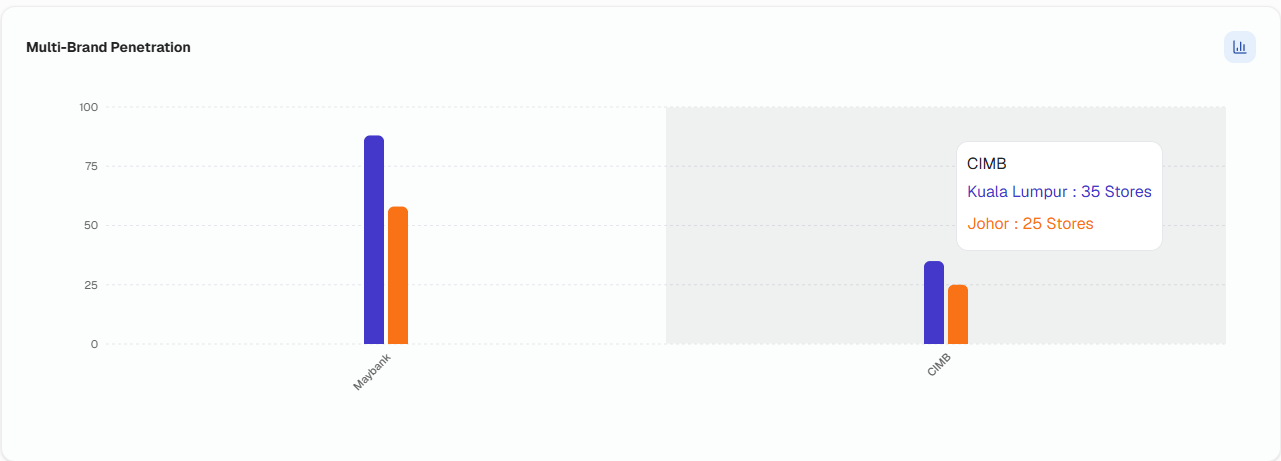
By mapping existing outlets in relation to competitor brand networks on a single 2D map view, Scrappy helped the team move away from slow manual spreadsheet scouting to instant geographic gap mapping.
Load Maybank, CIMB directly into the Scrappy dashboard and explore the raw spatial data yourself.
Analyze Data Now