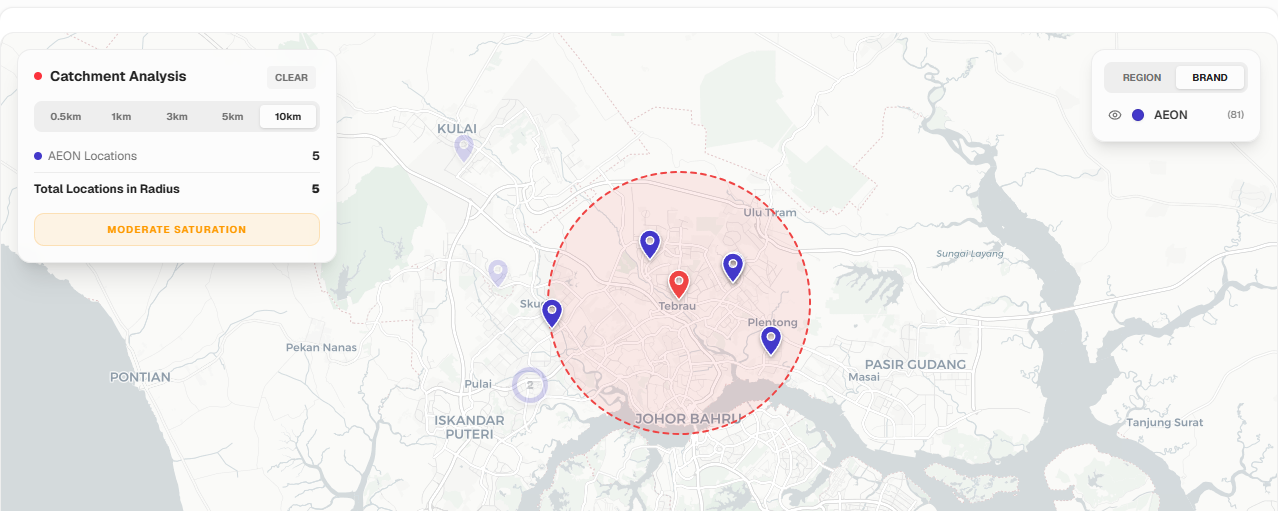
The Challenge: Defending the Catchment Against the Apex Retail Threat
Malaysia's commercial real estate ecosystem has long been anchored by institutional "Mall Kings"—behemoths like Mid Valley Megamall and Sunway Pyramid. For decades, these massive assets functioned as unchallenged regional monopolies, dictating retail trends and enjoying guaranteed footfall. However, the hyper-aggressive injection of new, ultra-luxury "Apex" developments (such as The Exchange TRX and Pavilion Bukit Jalil) has fundamentally shattered this equilibrium. The battle to retain high-net-worth (HNW) shoppers and premium anchor tenants has escalated into a high-stakes spatial war.
When a multi-billion Ringgit competitor launches just 10 kilometers away, established retail ecosystems face an existential and immediate threat of "Catchment Drain." The massive gravitational pull of these new developments warps existing consumer mobility patterns. Established mall operators can no longer rely on historical prestige to survive; they face three critical, data-driven defensive challenges:
- Tenant Anxiety and the "Flight to Prestige" Risk
The premium anchor tenants that define a mall's valuation—luxury fashion houses, international F&B chains, and experiential flagships—are inherently flight risks. When a shiny new Apex mall opens, these brands are heavily courted to relocate or prioritize their new flagship stores. Consequently, legacy landlords are facing intense, data-hostile lease renegotiations. Tenants now demand empirical, mathematical proof that their existing stores will not suffer catastrophic footfall erosion. "Trust our legacy" is no longer a viable retention strategy; mall management must provide granular spatial evidence of their ongoing, localized dominance to prevent a mass exodus of Tier-1 brands. - The "Shared vs. Loyal" Divide and Catchment Vulnerability
A mega-mall’s catchment area is not a static, uniform circle; it is a highly dynamic and vulnerable ecosystem. To effectively defend against a new competitor, mall management teams must mathematically dissect their consumer base. They must clearly identify their "Loyal Core"—shoppers heavily insulated by immediate proximity, habitual behavior, and high transit friction to the new mall. More importantly, they must map the "Shared Fringe." This fringe demographic represents highly elastic consumers who sit perfectly on the geographical borderline. These are the shoppers most vulnerable to being poached by the novelty of the new competitor. - Defensive Spatial Capital and OPEX Bleed
When faced with catchment drain, the traditional mall response is to bleed Operating Expenses (OPEX) through blind, mass-market promotional campaigns and massive mall-wide discounts. However, without precise geospatial intelligence to pinpoint exactly where their vulnerable fringe shoppers live, marketing budgets are hopelessly wasted on the loyal core who would have visited anyway. The critical challenge is acquiring the spatial analytics required to deploy highly targeted, defensive marketing capital precisely into the overlapping conflict zones. Malls must algorithmically defend their borders to ensure their Gross Turnover (GTO) rent models do not collapse under the weight of the new competition.